Sunday is a special day for most Kenyan urban families. Working class families particularly relish it as a ‘family day’. For Christian Kenyans, Sundays start with a family church service. Men love Sundays afternoon outings because being under their wives’ watch they are free to take as much of their favourite drinks as they can with no worry at all about later having to explain the thinner wallets or the lapsed hours. The children and their mothers particularly love it because church is always followed by a family day out where children are free to indulge their gustatory fantasies unhindered and their mothers joining in too are also happy to have their husbands’ un-interrupted presence and attention. Because Saturday holidays for Kenyan men belong to the clubs as they belong to the beauty salons and chamas for their wives, couples being separated worry about their partners getting into some secret indiscretions. Come Sunday everyone is worry-free but jealous and protective of their partner so as to atone for Saturday's sins and honour the family day while enjoying all its attendant benefits.
Urban, modern foods
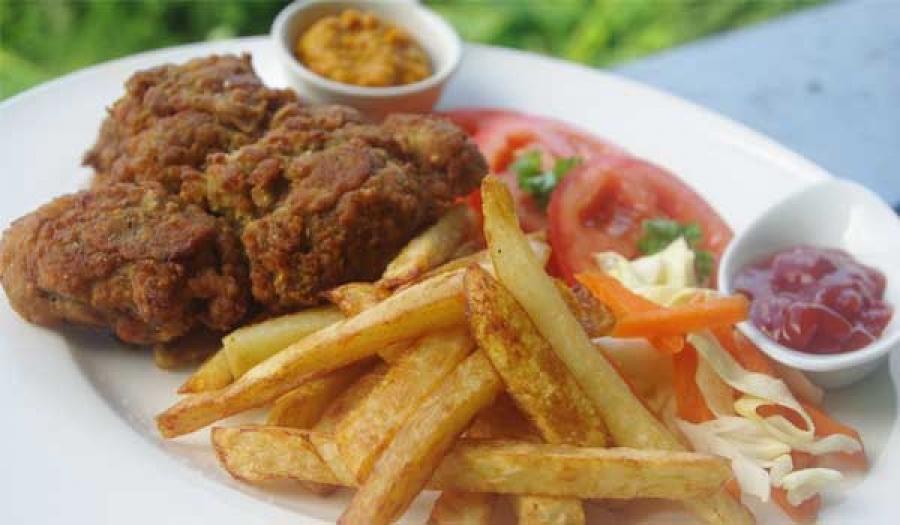
I am not a regular church worshipper but whenever I can I go through the whole two-part Sunday routine or my family drags me out to an after church for the family day session. While there I often watch trays of ‘urban’, ‘modern’ foods come to my table and more trays go past my table. The favourite foods for most urbanites are starches, meats and poultry, all fried in ponds of fats and oils, lavishly coated with tomato paste and mayonnaise and washed down liberally with pints of sweetened alcoholic and non-alcoholic drinks. Fruits and vegetables are rare and whenever they appear are in little quantities. The feasting goes on for hours. Afterwards the children will go off to bob their over-stuffed bellies on the bouncing castle or for face-painting and amusement by a clown as their parents sip more sweetened drinks and chatter while reading the newspaper or watching the English Premier League. As the day ends the satiated and inebriated family lumbers away to their car and drives home where house-helps lay out more of the same foods and drinks on their dinner tables. Weekend thus far is well spent. Satiety - beyond maximum. Physical activity - below minimum.
From a public health perspective however some key misconceptions are created in the process, which contribute to family obesity. Misconception about food - more, sweeter, fattier, meatier is better. Misconception about physical activity – exertion should be avoided at all costs. Kenyan doctors have warned that in many working class families obesity which previously was a problem of a few adults has now ‘devolved’ down the age groups to afflict children. One does not need to look too hard around in urban areas for them to see that this is true. Unlike before, obese children some below 10 years of age can now be found in some working class Kenyan families. This was previously a problem that was confined to some wealth-owning upper class families. It means therefore that the weight problem is growing and is becoming a public health issue. The greater public health concern however is that family knowledge and attitudes about lifestyles, food and nutrition and body weight are deficient and often harmful. If nothing is done to reverse it the problem will grow as more Kenyan move above the poverty line.
When your calorie intake exceeds requirements
Body weight is graded in ascending order from underweight, normal weight, overweight to obesity. Your ideal weight depends on your age, sex, body frame, height, occupation and level of physical activity. Ideal weight will thus vary from person to person and will change throughout a person’s life. Weight gain occurs when your food or calorie intake exceeds your requirements for maintaining your body in its present state and the extra calories are stored as bigger and bulkier organs and tissues. In common language you grow fat. Fat people are more likely than normal weight people to suffer from health problems like diabetes, hypertension, heart attack, stroke, arthritis, sleeping disorders and reduced sexual activity. They also become inactive and suffer low self esteem which affects their performance at home, social events, school and work. Children suffer these effects as much as adults.
So why is the problem of obesity growing and devolving down the social classes? Is it due to a new abundance of food and means? Are we knowingly or unknowingly causing obesity in ourselves and our children? Do we have beliefs, practices or attitudes about food and nutrition which encourage obesity in our families? What can we do as Kenyans to arrest and reverse this problem?
Deliberate overfeeding
I believe nobody knowingly occasions any of the above health problems in themselves or their loved ones by deliberately overfeeding. The increase in obesity is therefore a result of a new abundance of food and means occurring in families where ignorance, harmful beliefs, practices and attitudes about food and nutrition occur. In short new found wealth is meeting old resilient ignorance. The Sunday family day scenario I narrated is an example of this sorry state of affairs. We need to debunk myths that exist in our midst that certain foods especially vegetables and fruits when served alone on our meal tables are an indicator of poverty and hard times. Let us consume less processed sugar which apart from the teaspoonfuls of sugar we add to our tea, is abundant in the accompanying snacks. Sugar is also abundant in alcoholic and non-alcoholic drinks, dairy products and processed foods we buy from the supermarkets. Instead of frying most of our cooking let us use alternative and healthier methods like boiling, roasting and steaming. For those who love nyama choma and alcohol let us moderate our consumption. Let us also observe regular abstinence during which time we can take up a sport, hit the gym or jog with the rest of the family who will also benefit greatly from increased physical exercises.
These behaviour modifications can be challenging at the beginning but one day at a time and they will become healthy family traditions which we can bequeath to the next healthy generation.
The author, Dr Amulundu is an infectious diseases and public health specialist and acting Dean of the School of Health Sciences South Eastern Kenya University.